Specific Knowledge
Specific knowledge is knowledge that cannot be easily trained into someone else. It is usually discovered through genuine curiosity, unusual background, obsession, taste, or traits that feel natural to you but look difficult to others.
Core Idea
If society can train someone else to do what you do, society can replace you. Specific knowledge is valuable because it is tied to who you are and how you learn, not only to a credential.
It often appears as:
- technical creativity
- sales ability
- unusual taste
- fast learning in a niche
- communication style
- pattern recognition
- obsessive interest
- a rare combination of domains
How To Find It
Look for:
- what you did effortlessly as a child or teenager
- what feels like play to you but work to others
- what you keep learning without external pressure
- what people ask you for help with
- where your curiosity meets something society wants
This connects to ikigai, but it is more economically precise. Ikigai asks what makes life meaningful; specific knowledge asks what only you can bring to the market.
Connection To Learning
advice-on-upskilling emphasizes high-volume deliberate work. Naval adds a selection rule: do not grind indefinitely in a field where you have no natural pull. High effort compounds best when aimed at a domain where curiosity, aptitude, and market demand overlap.
Connection To Identity
Identity-based habits (from Atomic Habits) operationalize specific knowledge. Naval says "be yourself" because no one can compete with you at being you. Clear says "every action is a vote for identity." Together: discover what feels like play (specific knowledge), then build habit systems that compound daily votes for that identity. The person who naturally loves the domain and has automated the basics will outcompete someone forcing discipline in a mismatched field.
Timeless vs Timely Specific Knowledge
Naval draws a distinction between two flavors in how-to-get-rich:
Timeless specific knowledge — persuasion, charisma, taste, communication style, game-theory intuition. These skills were valuable in 1900 and will be valuable in 2100. They tend to be the ones "that can pretty much never be taught" — they have to be lived into.
Timely specific knowledge — machine learning in 2010, blockchain in 2015, AI coding workflows in 2025. These are specific because the frontier is moving fast enough that no training program can catch up. They are valuable for a decade or two before the next wave resets the edge. The best career stacks timeless on timely: broad judgment capabilities sitting on top of a rapidly-developing technical domain.
The technology frontier is structurally favorable for specific knowledge because it keeps creating new domains where experience doesn't yet exist. If you arrive early enough, your on-the-job learning constitutes the entire corpus of expertise in that area.
Recognizing It From Outside
Often you can't see your own specific knowledge from the inside — curiosity feels like distraction, obsession feels like dysfunction. Naval's anecdote: he spent his youth announcing that he would become a scientist, while his mother watched him critique the operational logistics of every restaurant they walked past. She knew before he did.
Two external signals that you've found it:
- Other people ask you for help with this thing specifically.
- You do it voluntarily, often without anyone noticing or compensating you.
Redefining the Arena
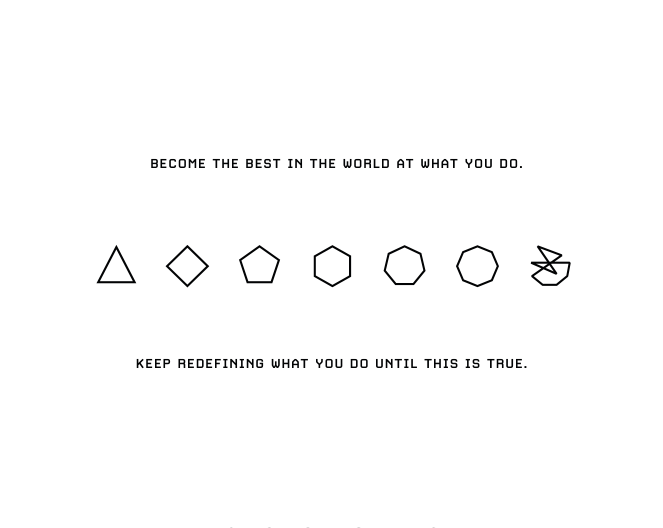
Because specific knowledge is tied to who you are, it cannot be reached by copying someone else's path. Naval illustrates this with a sequence of shapes: the goal is to "become the best in the world at what you do" — and if you cannot beat the world at the current definition, you keep redefining the arena until you are the best at the intersection only you occupy.
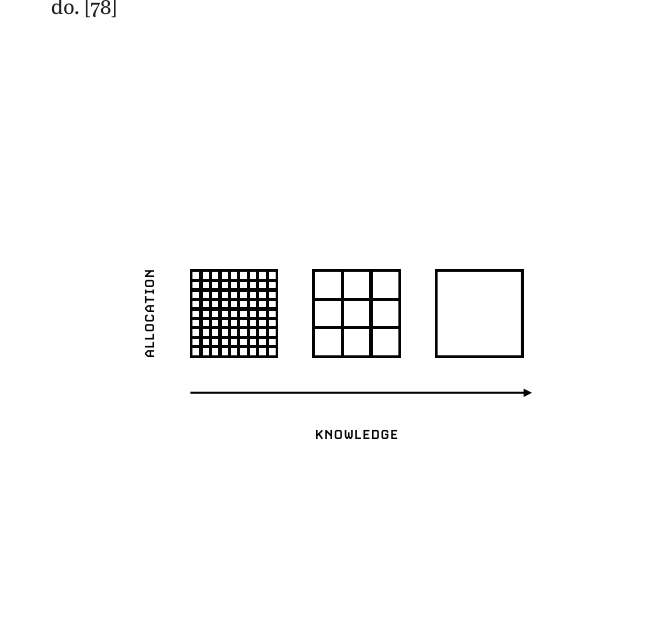
As your knowledge deepens, the allocation pattern shifts — you move from spreading effort evenly across many bets toward concentrating on fewer, larger ones where your edge is greatest:
The Skill-Stack Extension
Scott Adams' observation (cited by Naval): you don't have to be world-class at any single thing. Being in the top 25% of two or three things that rarely combine may make you effectively unique at the intersection. The combinatorics rapidly shrink the competition. Top-25% at finance + top-25% at writing + top-25% at network understanding = the kind of profile that gets to say things nobody else is positioned to say. The key: let the stack emerge naturally from your interests rather than assembling it deliberately for a career outcome — forced stacks reveal themselves as inauthentic.
This is a miniaturized form of the polymath strategy. Burke's historical analysis shows that the most impactful polymaths were not polymaths by design but by temperament — curiosity drove them across domains, and the cross-domain pattern recognition accumulated as a byproduct. The skill-stack works the same way: the intersection becomes specific knowledge precisely because it wasn't deliberately engineered for that purpose.
Munger's Version: The Latticework as Specific Knowledge
Munger doesn't use the term "specific knowledge," but his mental-models-latticework is a concrete example. His unique combination of law, psychology, economics, and investing creates a cross-domain pattern-recognition ability that is extremely hard to replicate. His Planck vs Chauffeur distinction maps directly: Planck knowledge is specific knowledge that has been earned through real engagement; chauffeur knowledge is the trainable surface that Naval says society will replace you for.
Munger also adds that trustworthiness — a seamless web of deserved trust — is itself a form of specific knowledge. It compounds over a lifetime and cannot be faked or trained into someone quickly.