Permissionless Leverage
Permissionless leverage is leverage that does not require someone else to give you capital or agree to work for you. The three types of leverage aren't equal in access: labor and capital are permissioned (someone has to follow you; someone has to fund you); code and media are not.
The Full Leverage Hierarchy
| Type | Description | Permissioned? | Era |
|---|---|---|---|
| Labor | People working for you | Yes — requires followers | Pre-industrial |
| Capital | Money multiplying decisions | Yes — requires trust or prior wealth | Industrial |
| Code | Software running without creator | No — any laptop | Internet age |
| Media | Distribution without creator | No — any microphone | Internet age |
The scale gap between permissioned and permissionless leverage is not incremental — it is discontinuous. Naval visualizes it as a box: labor effort multiplies by 1×, while code or media output can reach 10,000×:

Naval in how-to-get-rich: "The robots are already here. They're in the data centers. Every great software developer has an army of robots working for him at night. The bottleneck is just figuring out intelligent things to tell them to do." The "robot army" metaphor captures what code leverage actually feels like once you can write it.
Labor leverage is the worst form despite being the most legible socially — "how many people work for you?" is a status question, not an efficiency question. Managing people requires politics, alignment, and oversight. Capital leverage is powerful but required the last century's financial infrastructure to access. Code and media require only internet access and the will to produce.
Why Permissionless Changes the Game
Permissioned leverage is zero-sum at the point of access. The person giving you capital or following your direction retains control. Permissionless leverage is unilateral. You can write a book, publish a podcast, ship software, or create a YouTube channel without anyone granting you the right. The internet made this possible at scale for the first time — before it, broadcast media was gated by distribution channels that extracted most of the economics.
This matters for specific knowledge because niche obsession can now find a niche audience. The internet connects every person to every other person. A pre-internet expert in a narrow domain was limited to their local market. Post-internet, the world's 50,000 people who care about exactly your thing are now reachable.
Egalitarianism of Code and Media Output
One underappreciated property: code and media products are consumed identically across wealth levels. Jeff Bezos doesn't get better Google results. He can't watch Netflix at higher quality. The same podcast lands in his headphones as in yours. This means the product that serves the most people will have the largest budget — and often the highest quality. The entertainment with the biggest budgets isn't made for the rich; it's made for the mass audience, because zero marginal cost makes mass scale the most profitable scale.
Labor and capital produce inegalitarian outputs (a private chef, a private plane). Code and media produce egalitarian outputs. If you care about building something that matters — not just something that extracts — code and media are structurally better aligned with genuine value creation.
The Archimedes Point
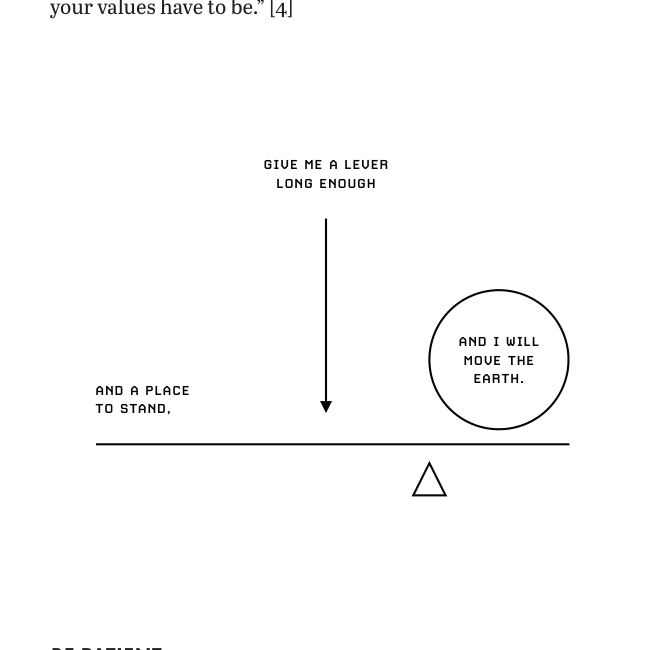
Naval returns to the Archimedes lever as the canonical illustration: "Give me a lever long enough and a place to stand, and I will move the world." Code and media are that lever — the fulcrum is your specific knowledge, the lever arm is distribution, the load is value delivered.
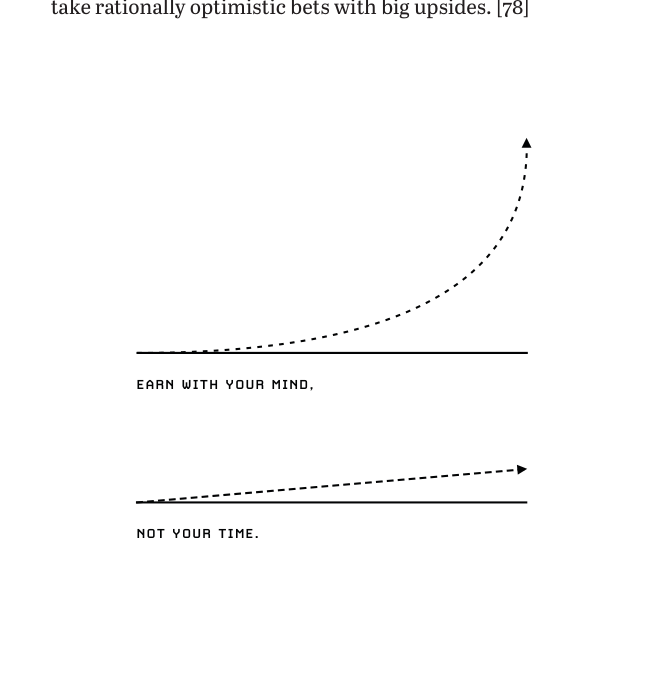
The exponential curve vs. the linear one captures the same point for earning: trading time for money (employment) is a linear function. Leveraging judgment through products that scale is an exponential one. At small scales the curves look comparable; at large scales they are incomparable.
Leverage Magnifies Judgment
The caveat Naval is clear about: leverage is a force multiplier on whatever you apply it to. Applied to good judgment, it produces wealth. Applied to poor judgment, it scales errors. This is why he insists the sequence is: specific knowledge → accountability → leverage, not leverage first. Hustling to get leverage before you have judgment is a way to make bigger mistakes faster.
AI coding agents are an extension of code leverage — they let judgment and task design produce output without requiring proportionally more labor. The bottleneck shifts from execution to the quality of what you tell the agents to do.
Habits as the Compounding Engine
Leverage only compounds if you show up consistently. Atomic Habits makes the connection explicit: habits are the 1%-per-day compounding mechanism that turns leverage into results. Without automated daily systems, leverage sits unused. The Plateau of Latent Potential explains why most people abandon their leverage projects before compounding kicks in.